Thursday, 11 April 2013

Doughnuts Part 2 – Fennel and Raisin Custard

After the last nerve-shredding excursion to doughnut hell, I can hardly believe that I’ve managed to summon the sheer brass bollocked fortitude needed to make another attempt, but I have and this time, things were different.

First of all, I tried out a new flavour combination. Inspired by the rather bloody superb fennel and raisin bread available from Harts Bakery, (Located just around the corner from Bristol’s Temple Meads station) my doughnuts would be stuffed with fennel and raisin custard and would taste, it turns out, frigging uber. Even if I do say so myself.

Secondly, I actually followed my pastry chef mate’s tips, advice and amendments to the published St John doughnut recipe.

If you read my last post on the subject of doughnuts, you may be asking yourself why try again, Dan? Why Dan? WHY?!

Well, if I’m honest, my ridiculous sense of perfection and my mungus ego was left critically wounded by how much of a massive ball ache I found the whole process last time. I just ‘had’ to have another go at it and confirm that I’m the absolute frigging daddy / an utter half-baked cretin (delete as applicable).

Well yep, I’m pleased to report it’s cheesy grins and congratulatory back slaps all round as a sweet yeasty doughnut smell of success pervades my smug old ass right now. I honestly couldn’t be more chuffed with how they turned out this time. I rock. Totally.

If you too fancy grabbing yourself some of this impossibly self-satisfied conceit, here’s what you’ll need in addition to the doughnut recipe from my previous post, HERE.

Fennel & Raisin Custard Doughnut

You’ll Need: -
6 Tsp Fennel Seeds, Crushed (to infuse the crème patissiere)
200g Raisins
2 Tbsp Fennel Seeds, Crushed (to dust the doughnuts).

First, as my chef friend advised, after mixing your dough, don’t leave to rise as the original recipe advises, place it straight into the fridge. I made it in the evening and left it in the fridge overnight. The resulting dough was much firmer and easier to handle than on my previous attempt.

I weighed the dough out into 50g per portion, before rolling into balls to rise, with my hands coated with a little sunflower oil.

Also as advised, I placed the doughnuts on greaseproof paper, two to each piece.
When it came to frying, (at 175C) I dropped both into the fryer at once, paper and all, holding onto the edge of the greaseproof and pulling it away as they dropped into the hot oil. This saved me handling the doughnuts and squashing them, something that caused me so much frustration last time.

When dusting your just fried doughnuts add a couple of tablespoons of finely crushed fennel seeds to the caster sugar.

The other changes are to the crème patissiere recipe, at the beginning; add 6 tsp of crushed fennel seeds to the milk and vanilla pods mix to infuse.

Finally, pour boiling water over the raisins and leave them for a few minutes, to puff up a bit, before straining and stirring through the finished crème-pat. No one likes a flaccid raisin.

So that, as they say, is that. I can hold my head high (and suck my stomach in even more) I have persisted and prevailed over doughnuts!
* Wild Applause*

Saturday, 23 March 2013

Bacon and Bourbon Custard Doughnuts

Before last week, I had never made a doughnut. Yes *pats belly* I have eaten muchos many, but actually crafted a sugary orb of loveliness with my own fair hands? Tres massive non.

Looking back now, what prompted me then to sit up and declare ‘I shall make doughnuts this day’ (because that’s how I actually talk), I have no idea. I obviously had a yawning circular shaped chasm in my life that needed to be filled, totes Freudian. But anyway. I did it and bloody hell, what a journey it was. A whole day of mixed emotions, ok, I say mixed, it was pretty much howling anger and frustration but at the close, there was just a tiny measure of delight.

You see, I found making doughnuts to be a complete and utter fucking ballache from start to end, but the finished, aesthetically misshapen, fried sugar dusted globes, oozing bourbon custard specked through with caramelised bacon were an absolute joy to eat.

Where did I get the inspiration for bacon and bourbon custard doughnuts? I have no idea. It just came to me in a similar boss-eyed brain flash that brought you celery ice-cream (yay) served with hot Stilton fritters (errr retch). My noggin just spits out stuff, that’s how it works. Sometimes it’s ‘mazers. Sometimes it’s totally ming. There’s no way of knowing until I actually make whatever it happens to be. Thinking about it, in all honesty, there’s probably a combination of influences at work, from the BBQ flavours in the day job as a manager at Grillstock to the incredible oxtail doughnuts at Duck at Waffle.

I decided to adapt the St John doughnut recipe from Beyond Nose to Tail, theirs are generally considered to be the best example money can buy (although if you’re reading this and are Bristol based, check out Pippins doughnuts, every Friday at Corn Street market – made by a former St John pastry chef, they’re just as good, unsurprisingly).

Towards the end of the doughnut making process, when I was feeling utterly broken, covered in a combination of flour, dough and desperation with every single bare surface in the wreckage of my kitchen littered with discarded ingredients and equipment, like a far warmer, gastronomic version of Napoleon’s 1812 retreat from Moscow; salvation came.

I’d forgotten that a friend of mine was until recently a pastry chef at the St John Hotel and was just a bit more than au fait with the whole doughnut making process. No doubt observing my blood curdling, profanity laden doughnut hell via the medium of Twitter, he offered to email me some tips and addendums to the published St John recipe, based on his own professional experiences. This much-needed lifeline came too late for me friends. I will be forever mentally scarred by my delicious but ugly doughnuts sat there, silently mocking my herculean baking efforts, just by their very existence.

But this need not happen to you. I’ve added my chef friend’s observations to the recipe, so if you attempt it yourself, you’ll be better prepared than I was.

The doughnuts themselves are delicious. The bourbon flavoured custard is subtly boozy, the caramelised bacon bits, salty-sweet and you know…as porky as you’d expect. If you’re really not sure about the meat element, leave it out. I’ll forgive you. Sort of.

One final observation. Crème patissiere is the f*cking daddy. I’ve never made it before and to say I was massively impressed is something of an understatement. Holy shit, I couldn’t leave it alone. Sneaking back for sly spoonfuls, smearing it in hot cross buns, mainlining it intravenously…. perhaps not the last one…yet, but you get the idea. Consider yourselves warned and go purchase some fatty trousers now.

Bacon and Bourbon Custard Doughnuts
Makes 25

You’ll need a freestanding electric mixer with the beater attachment (like my faithful KitchenAid, Klaus Von Battenberg).

You’ll Need: -
500g strong white flour
65g caster Sugar, plus extra for coating
10g salt
15g fresh yeast
4 large eggs
Grated zest 1 lemon
155ml water
125g softened unsalted butter
Sunflower oil for deep-frying

Place all the ingredients except the butter and the oil in the bowl of the mixer. Mix on a medium speed for 6 minutes, then scrape down the sides of the bowl.

Start mixing on a medium speed again, adding the soft butter about 20g at a time until all incorporated. Keep mixing for 6-8 minutes, until the dough has come away from the sides of the bowl and looks smooth, glossy and elastic.

Place the dough in a large bowl, sprinkle the surface with flour and cover with a tea towel. Leave to rise for 2-3 hours in a warm place, until doubled in size, then knock back the dough. Cover the bowl with cling film and place in the fridge for at least 4 hours or overnight.

Cut the dough into 25 pieces and roll them into smooth balls. Place on floured baking sheets, leaving about 5cm between each one. Cover with cling film and leave to prove for 2-3 hours, depending on how warm it is; they should double in size.

Heat your deep fat fryer to 190C

With the oil at the right temperature, start frying the doughnuts in batches of 3 or 4. They will take about 2 minutes on each side. Remember to check the temperature of the oil between each batch, as the doughnuts are done; place them on kitchen paper to soak up the excess oil and then toss in caster sugar.

To fill your doughnuts, you will need a piping bag with a nozzle. Make a hole in each doughnut with a small knife and pipe in the filling, about 4 Tbs per doughnut.

Here’s the Bacon and Bourbon Crème Patissiere recipe for the filling.

Makes enough to fill 25 doughnuts (that’s handy then).

You’ll need:-
2 vanilla pods
1 litre full fat milk
12 large egg yolks
130g Caster Sugar
80g plain flour
250ml lightly whipped double cream
3-4 Tbsp Bourbon Whisky
8 rashers streaky bacon
8 Tbsp brown sugar

First, lay the bacon out on a silicon-baking sheet or foil-covered tray, sprinkling each piece with the brown sugar. Place in a 200C oven and bake for 12-16 mins. Halfway through, flip them over. When dark brown, remove from the oven and cool on a wire rack. Once cooled, chop into small pieces (remember, they have to go through a piping bag nozzle).

Next, make the crème patissiere.

Slit the vanilla pods lengthways and scrape out the seeds. Put the pods and the seeds in a saucepan with the milk and bring to the boil over a medium heat.

Meanwhile, mix the egg yolks and sugar together in a large bowl. Sift in the flour and whisk it all together. When the milk is boiling, pour it over the egg mixture, whisking all the time. Then return the mixture to the saucepan and slowly bring to the boil over a low heat, whisking occasionally.

Once it is boiling, whisk continuously for about 5 minutes, until very thick and smooth. Strain through a fine sieve into a bowl and cover the surface with cling film to prevent a skin forming. Leave to cool, then chill.

When you’re ready to fill the doughnuts, fold the whipped cream through the crème patissiere to lighten it and, stir through the chopped caramelised bacon and the Bourbon whisky.

Now, before you dive in and start madly churning out doughnuts here’s what my friend Sam, ex St John Hotel pastry chef has to add to the recipe and doughnut making in general…

Firstly, I think you can drop 5ml of water from the mix. This is probably one of those little things that creep in when you scale up/down recipes.

Second, you need to really mix it well before the butter goes in. The instructions in the book are misleading I think. I used to do it for 10mins on medium speed until the dough is really glossy and comes away from the sides of the bowl. At the start that seems unlikely but then it works and looks like proper dough! Once at this stage, add the butter, which needs to be properly soft. I add it a bit at a time, mixing slowly until it's all incorporated, then turn up the speed and give it a 3-minute blast, to really make sure the butter is properly combined.

Thirdly, we used to just stick the dough straight in the fridge, as leaving it out is going to make it overprove before it's chilled enough for shaping. When you refrigerate fermenting dough there's a degree of inertia - dough takes a while to chill, and it's fermenting all the time, so there is a tendency for it to overprove even in the fridge. I think if you leave the dough out before fridging, then overproving is guaranteed. It'll be pretty warm from the mixer anyway. I find they are best to mix the dough in the morning, then pop in the fridge all day, then fry in the evening, but the dough is good in the fridge 3 days as long as it went straight in there from the mixer.

Shaping wise: with the dough really cold it'll be a lot easier. Oil on the hands stops it sticking, and on the scales etc. Oil some pieces of baking paper which are large enough for the amount of doughnuts you can fry in one go, say 2, then when you fry you can drop the whole paper with dough straight into the fryer instead of having to manhandle them. You can drop the paper in the oil, just keep hold of one bit so you don't burn yourself taking them out again, they need to be kind of submerged so the doughnut cooks off the paper.

When you shape, you don't need to do much, but to get them very regular you need to shape them like a bread roll, taking the edges of the piece into the middle, one at a time, each time it stretches the dough and provides shape, then roll it between your hands 'til it's smooth. Hard to explain really.

Fry at 175c, not 190. They are best within an hour, but fine for a day.

Staff fave for leftovers is one bunged in the oven to warm, then cut open with a scoop of chocolate ice cream inside... Naughty.

So there you go, hopefully with the original recipe and these doughnut shaped words of wisdom from Sam, you won't have a nervous breakdown, like I did.

Massive thanks again to Sam for taking the time to email me such useful advice.
Follow him on Twitter @samjleach

Sunday, 10 March 2013

Gypsy Tart

When I was a child I’d get taken on summer daytrips to the seaside at Southend. These were elaborately arranged affairs where we’d arrange to meet my grandparents, aunties, uncles and cousins from East London and all head to the Essex coast by train. We’d get off at Leigh on Sea, breathing in that immediate, almost alien hit of seaweed and salty air and stroll excitedly past the cockle sheds, through the old town and down the baking hot tarmac path alongside the beach until it was decided we’d halt and stake our claim on a piece of sand. Out would come the wind breaks, towels and deckchairs, picnics and buckets and spades.

I’d paddle in the sea, make sandcastles, spread ice cream across my face and no doubt piss my parents off by showing them every shell I came across. Every now and again I’d glance curiously out across ‘the sea’ wondering what France was like over there on the other side. I just couldn’t get my head around the fact that this vast expanse of water was actually the Thames and that distant land on the horizon was Kent. I’m older now, a little wiser, and although it’s not quite another country across the Thames, they do some things differently over there.

If you were educated in Kent, you’d undoubtedly have eaten gypsy tart. This curiously named, ridiculously sweet dessert is specific to the county and associated with school dinners. I think that’s fantastic. Britain has sadly lost much of its regional food heritage but here one item stands, unmovable, unapologetic. Bravo.

I’d heard of Gypsy tart, but never eaten it. However, a newly published wine magazine, Noble Rot, has recently pulled off something of a coup for their first issue in getting Michelin starred, Kent pub, The Sportsman to provide a recipe for their first issue. Straight away, I was all over this. I’d say the best meal I’ve ever eaten was the tasting menu at The Sportsman and it’s rare to see Chef and owner, Stephen Harris’s recipe’s appearing in print. All around a result then.

I had a go at making The Sportsman’s Gypsy Tart recipe. Twice. I pretty much ate the first one to myself. Elly had a slice, but to my shame, I ate all of the rest over a couple of days. What can I say? I’m an absolute evaporated milk fiend.

As I thought it was so good; I made it again the following week for a dinner party.

The method of slicing the pastry and pressing into the tin to avoid gluten development is new to me, but it worked really well.

Overall, I bloody love this recipe; it’s relatively cheap, simple and tastes superb, especially with a blob of Jersey cream on the side.

Gypsy Tart

This recipe makes one tart.

Ingredients:
For the pastry (you may end up with far more pastry than you need, but it’s not really worth making less – it freezes well anyway):

250g butter, softened
500g low-gluten flour
190g sugar A pinch of salt
2 medium eggs, beaten
Egg wash, to glaze

For the filling:
410ml canned evaporated milk
350g Muscovado sugar

Method:
Cream the butter and sugar until the sugar has dissolved, then beat in the eggs.
Now, by hand, mix in the flour and salt, and knead until you have a pastry dough.Roll into a cylinder and chill until hard.

You don’t want to roll this pastry, as you want to avoid gluten development, so once it’s hard,cut as much of it as you need into enough 5mm-thick discs to line a 20cm tart ring (freeze any excess pastry).

Wet your fingers, place the discs around the edges and base of the ring, and work gently together until they cover it in a smooth, even layer.
Prick all over with a fork then chill.

Fill the case with baking parchment and baking beans, and blind bake at 180C

Remove the paper and beans, turn down the heat to 160C/320F/gas mark 2 and cook until the pastry is an even brown.

Remove, brush with egg wash, and return briefly to the oven to seal.

To make the filling, whisk the cold milk and sugar in a bowl for 10 minutes until you have a light, airy emulsion. Pour into the pastry case and bake at 160C/320F/gas mark 2 for 15-20 minutes.

The filling should be just set, with a slight wobble. There will be a few bubbles on the top and it will show signs of having risen.

Leave to cool until set.

Massive thanks to Noble Rot magazine and The Sportsman for allowing me to reproduce the recipe here.

Monday, 4 March 2013

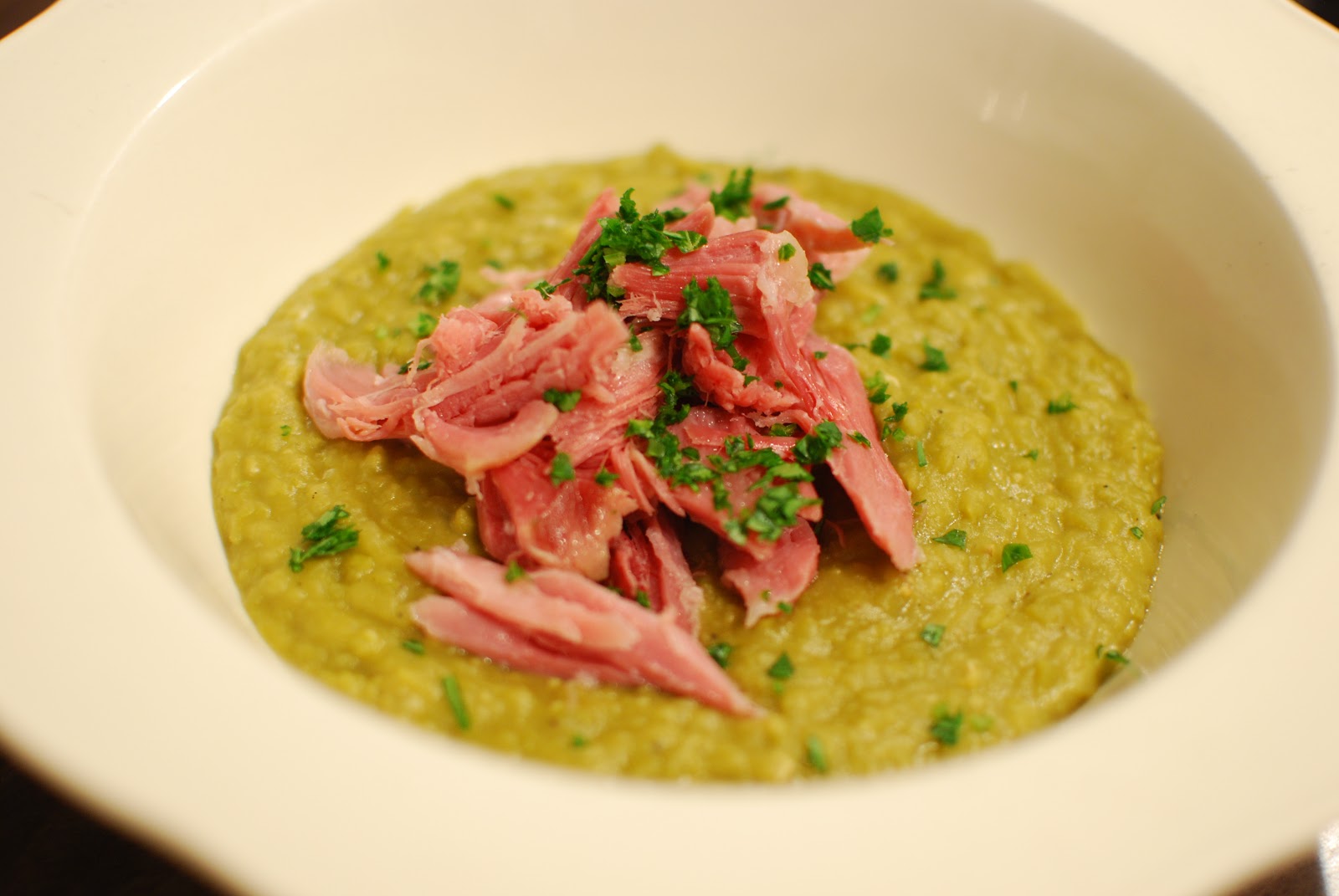
Pease Pudding and Ham Hock

In these recession-ravaged times, food frugality is to be clutched to the metaphorical bosom. But cheap ingredients aren’t necessarily a poor substitute. A recent dinner of pease pudding and flaked ham was one of the best things I’ve eaten in bloody ages and it doesn’t really get more frugal than that. Split green peas, 50p. A ham hock that admittedly looks like the sort of offcut you might buy as a treat for your pet dog, £1.99. A bit of root veg to sex it all up, say a couple of quid, and you have dinner for 4 and a load of stock left to make soup with.

For me, pease pudding and flaked ham hock is evocative of the old East London I briefly glimpsed as a child in my nan and granddads kitchen, before the family’s exodus to Essex.

Pease pudding is now thought of as an exclusively Northern dish, but there was a real tradition of eating it in East London. Growing up, my Mum’s favourite dinner was Ham or boiled bacon, pease pudding, boiled carrots and potatoes (tres boiled, yeah). My granddad used to cook the split peas in a muslin bag along with the hock.

If there was some left over, the next day, cold pease pudding, ham and mustard sandwiches were another of my Mum’s favourites.

Even if they didn’t cook it at home, pease pudding was often on the cards. As a little girl, my Mum remembers ‘Webster’s’ a delicatessen opposite East Ham town hall, on the Barking Road selling pease pudding from a pot on the marble counter, slapped into grease proof paper and eaten along with saveloys or ‘very peppery’ meat pies which must have been at the dying end of a tradition that novelist Walter Besant wrote about in his book ‘East London’ published in 1901 – which describes an evening trade of ‘faggots, saveloys and pease pudding’

With all this family food heritage, I’m almost ashamed to say that, it was only the other day that I first tried cooking pease pudding and a ham hock myself. It definitely wont be the last time. It was astoundingly good. Pease pudding is subtle, peppery and strangely comforting. Topped with the slightly salty and rich ham hock and loads of white pepper, incredible stuff.

Even if you don’t fancy making the pease pudding, the ham hock is worth doing on it’s own. Life feels much more complete with some lumps of ham to pick at along with a blob of mustard and some good bread and butter.

If you fancy pushing the boat out and doing two ham hocks, you don’t need to add any extra veg, just bang them both in the pot.

I’d like to say this is an old East End family recipe, but I shamelessly pinched it from the always reliable, Gordon Ramsay’s ‘Great British Pub Food’,
Ham Hock and Pease Pudding

Serves 4

You’ll Need: -

1 large smoked or unsmoked ham hock, with bone. Soaked overnight in cold water
2 leeks, trimmed
2 celery sticks, trimmed
1 large carrot, peeled
1 large onion, peeled and halved
1 head of garlic, halved horizontally
2 bay leaves
few thyme sprigs
few rosemary sprigs
1 tsp black peppercorns

For the pease pudding: -

300g split green peas, soaked overnight in cold water.
1 small onion, peeled and finely chopped
1 tbsp butter
few dashes of Worcestershire sauce
white pepper
small bunch of flat leaf parsley leaves, chopped.

You’ll need to plan ahead to make this recipe. Both the ham hock and the split green peas need to be soaked overnight in cold water. It might seem like a load of faff but believe me, it’s worth it. In the case of the ham it’s a precaution to rinse out any salt present. It’s impossible to tell how salty it might be and there’s the possibility of ruining the finished dish As for the peas, it softens them and reduces the cooking time.

Rinse and drain the ham hock, then put into a large pan. Cut the leeks, celery and carrot into 5 cm lengths and add to the pot with the onion, garlic, herbs and peppercorns.

Pour in enough cold water to cover. Bring to the boil, skimming any scum from the surface. Cover with a lid and gently simmer for 2-3 hours, until the meat is soft and pulls away from the bone easily.

Remove the ham hock from the stock and set aside to cool slightly, before flaking the meat into pieces discarding any skin, gristle or bones. Strain the stock, and measure out 600ml for the split green peas.
For the pease pudding, strain the split peas and put them into a saucepan with the chopped onion. Pour in the reserved ham stock and bring to a simmer, then cover and cook for 2 ½ - 3 hours until the peas are soft and the liquid has mostly been absorbed. Add the butter and Worcestershire sauce and season well with white pepper (the original recipe suggests black – I don’t agree).

Serve the pease pudding in bowls, topped with flaked ham hock, chopped parsley and some more white pepper.

Thursday, 14 February 2013

Sussex Pond Pudding

I’m sure many would be surprised to learn that, despite my svelte athletic frame and whippet-like trim, where it comes to pudding, I favour traditional British varieties. Not for me the charms of an ethereally light, whipped to within an inch of it’s life, uppity frou-frou fancy, as favoured by our continental cousins and finer dining establishments. No. I want a bowl containing a ‘lump’ of pudding, definitely not a slice. Preferably consisting mainly of suet. It will be a squat, heavy almost leaden mass. It will be steaming hot. The only acceptable accompaniment will be cream or custard. This is the type of dessert that powered a globe straddling empire. Accept no substitute.

Is it any wonder then, when invited to dinner at the rather swanky Hix Mayfair (ensconced in Brown’s Hotel), for a meal that was planned, incidentally to celebrate duck (more about that later) I only had eyes for the dessert - the intriguingly named Sussex Pond Pudding. This was to be the first time I’d ever tried it. Of course I’ve heard mention of it, studied pictures and recipes but it always seemed a bit of an oddity. In case you don’t know, it’s suet based (praise be) but in the centre there sits a whole lemon. It’s always kind of put me off making it, as I just couldn’t imagine what it’d taste like or if it would be any good.

Well ladies and gentlemen, wiser and significantly plumper, I’m here to tell you it’s absolutely frigging top drawer. Hello sticky, sweet suet sitting in a puddle of buttery, caramel, lemon juices, get down my hatch pronto. One of the best British puddings I’ve ever tasted, possibly even better than spotted dick and that, is almost taking the piss.

I ate four massive portions. The rest of the assembled guests (including Mark Hix himself) looked on with what I can only describe as a mixture of awe, admiration, disgust and perhaps pity as I refused to submit and ate as much as I possibly could. Seriously, it was ridiculously good.

A week later, the memory of this exemplary pudding scored deep into my brain, I decided to have a go at making it myself.
I used Mark Hix’s recipe from British Food. It turned out looking exactly like the picture in the book, a broken, ruined skyline of suet with a lemon protruding through the rubble. The restaurant version unsurprisingly, was much neater. I notice they’re using shallower but wider bowls, perhaps that’s the trick. In any case it tasted amazing, even it if wasn’t exactly aesthetically pleasing. Elly wasn’t such a fan. This is verging on treason as far as I’m concerned. Over 3 days, I ate the whole bloody lot myself. Every last bit.

Here’s the recipe…

Sussex Pond Pudding

Serves 4-6 (or just me)

You’ll need: -

250g self-raising flour, plus extra to dust.
125g shredded beef or veggie suet
150ml milk
300g unsalted butter, softened, plus extra to grease,
200g soft light brown sugar
1 large unwaxed lemon

Mix the flour and suet together in a bowl, then gradually mix in the milk to form a dough. The dough should be soft but firm enough to roll out.

Roll out the dough to a circle large enough to line a 1.5 litre pudding basin. Cut a quarter out of the circle for the lid and to ease the lining of the bowl. Butter the pudding basin well, drop the pastry into it and join up the edges where the quarter was removed.

Mix the butter and sugar together and put into the lined basin. With a roasting fork or skewer, prick the lemon thoroughly, all over, so the juices can escape during cooking, then push into the butter mixture.

Remould the pastry for the top and roll it out to the correct size. Lay it on top of the filling and press the edges together to seal in the filling. Cover the top of the basin with a generous piece of foil, making a pleat down the middle to allow for expansion. Secure in place under the rim with string, making a string handle so it can be lifted out easily.

Lower the pudding into a pan containing enough boiling water to come halfway up the die of the basin, Cover and simmer for 4 hours, topping up with more boiling water as necessary.

To serve, lift out the basin and allow to stand for about 30 minutes, then remove the foil and loosen the sides with a small sharp knife. Put a deep serving dish over the basin and quickly turn the whole thing upside down – it may collapse a little (like mine did) but it’s to be expected.

Eat the whole frigging lot with cream, except the lemon, unless you REALLY like lemons.

As for the aforementioned duck dinner…
I was an enthralled witness to an immaculately turned out, white-jacketed waiter pouring a roaring napalm furnace of alcoholic fuel onto a duck pinioned upright, presumably by virtue of a pole up it’s harris. The heady smell of scorched flesh with perhaps a smidgeon of singed eyebrow wafted across the table. This act, played out in the luxurious, suave, civility of the wood panelled Hix Mayfair dining room, felt akin to Cary Grant taking a flamethrower to a Bichon Frise.

I highly recommend it.

Sunday, 10 February 2013

Meat Mission - London

There’s been something of a ‘junk food trend’ backlash of late with one of the more respected national restaurant critics bemoaning the fact ‘gourmet junk food’ was so prevalent in 2012. I can see her point, but now that I call Bristol home and have the perspective that 100 miles or so of M4 motorway gives, from where I’m sitting I’d say, it’s very much centred in London. Personally, I’m not quite tired of it yet.

Although there are more places than I can count on my fingers and toes churning out gourmet junk to stuff your gob with in the capital, there are not many who are actually doing anything that’s really original or interesting.

With these very thoughts framed in my tiny mind, I recently found myself in Hoxton heading to the latest incantation of Yianni Papoutsis’ rapidly expanding empire, Meat Mission.

I’d already eaten at the older siblings in the group, Meat Liquor and Meat Market. With regards to ML, I wasn’t quite convinced. Don’t get me wrong, the food itself was great (I’m a big fan of the Dead Hippie Burger) but I’d eaten there during the daytime and it was the general environment that I found a bit much; gloomy lighting, pounding music, wall to wall customers, indifferent service, artfully exposed wiring and graffiti. It almost felt like it was trying just a bit too hard, a kind of TGI Friday’s for Hipsters. To be honest, I couldn’t eat up and clear out fast enough.

Strangely enough, I liked Meat Market a lot more. Despite having much in common, menu wise, with ML it has a very different vibe; less Hollister’esque, and more New York-Japanese neon and chrome, industrial cool. Having eaten there a couple of times now, I’ve come to appreciate the concept a lot more and was really looking forward to trying Meat Mission.
Housed in a former Christian Mission, (hence the name) Meat Mission is pretty damn big, dark, loud and absolutely rammed. The pulpit and carved stone memorials remain in place, now bizarrely co-existing with a stained glass effect graffiti ceiling. Almost all the things I previously disliked about ML were present and correct, but weirdly I didn’t mind that much. I figure it’s because it was the evening, and that kind of atmosphere just feels right after dark. During the day, it’s just disorientating, a bit like when you’ve spent hours ensconced in the cinema and walk out, somehow expecting night and instead squinting in the late afternoon sun.
It was so heaving I ended up squeezing myself in at the end of the bar and studying the menu masquerading as a hymn sheet, nice touch. As well as the ML and MM classics, there’s a load of entirely new stuff. The sheer inventiveness of the menu is definitely one of the restaurant’s strengths. Yeah, it’s the usual filthy US inspired trash food ingredients but in most cases re-worked into something entirely new, combined with a cheeky wink and huge grin. It’s a hell of a lot of fun.

Briefly consulting the (mostly) ever-reliable oracle, Twitter, I’d been offered a pretty much unanimous consensus, on what I should be trying; Monkey fingers and Peckham Dip.
Monkey fingers; strips of chicken fillet encased in a strangely flabby batter, which is itself coated in a sticky chilli sauce were an absolute mess to eat, I got frigging covered in it, all over my hands, my face and up my arms. But there’s no denying they were bloody good. The portion is fairly hefty, which is no bad thing. The seemingly all-pervasive chilli coating had a nice kick and combined with a monkey finger dipped in the accompanying pot of blue cheese dip was total bliss.
Unfortunately for me and my dry cleaning bill, the Peckham dip was just as messy to eat. A roast beef and fried onion roll with a bowl of bone marrow gravy and some horseradish sauce. The idea here is you dunk the beef roll in the bowl of gravy as you eat, in the US this is known as a French dip, originating in Los Angeles. Lovely. But gravy dip aside, the beef roll itself was strangely reminiscent to me of a much loved fast food item from my youth, growing up in Basildon, Essex. It was suddenly 1am. I’m in a car park behind ‘The Lakes’ near Ashlyns roundabout, joining a raucous queue of taxi drivers, lairy drunks, furtive track suited teenagers billowing clouds of skunk and saucer eyed clubbers all shuffling slowly towards a glowing, steaming hatch and the most amazing steak rolls. Unbelievably the Peckham Dip tastes exactly like the ones I used to eat in Basildon, the same kind of seasoning, even the roll itself looks similar. Don’t get me wrong. This is no bad thing. I took many a wide, stumbling drunken, detour just to procure one of these so I was well happy. I doubt Meat Mission will be much flattered by the comparison though.

After that, I was stuffed silly; I pretty much rolled out of there on my stomach.

I liked Meat Mission a lot. Yep, it’s loud, busy and in your face, the closest comparison would be eating in a nightclub. But the menu is clever, inventive, fun and most importantly, the food is bloody good and pretty cheap. As a temple to Gourmet junk food, it’s one altar worth worshipping at.

Meat Mission
14-15 Hoxton Market
London
N1 6HG

Telephone: 020 7739 8212

Sunday, 3 February 2013

Salmon in pastry with currants and ginger

This is a really interesting recipe. Almost certainly ye olde English in origin, with it’s combination of spice, sweet fruit and fish, it became something of a signature dish in the 1950s-60s for George Perry-Smith at his groundbreaking Bath restaurant, The Hole in the Wall. Later, Chef Stephen Markwick who’d trained with Perry-Smith also had the dish on his menu, right up until his recent retirement. Interestingly, it doesn’t end there, Chef Andrew Griffin, at Tart Cafe in Gloucester Road, Bristol, who previously worked for Stephen Markwick has also been known to cook it. So, it’s been passed down through different restaurants and chefs for at least 60 years. How about that for a dish’s lineage, eh?

As for the recipe itself I doubt I’m the only one that struggles to envisage the combination of salmon with the sweetness of currants and preserved ginger, but what the hell, I gave it a go anyway and found it works ridiculously well. In fact it’s surprisingly subtle.

I served it with new potatoes, little gem (inspired by my recent lunch at Green Man & French Horn), and Hollandaise…that split, repeatedly just as I was about to serve up. Bastard.

The recipe below is pinched from the incomparable Roast Chicken & Other Stories by Simon Hopkinson; who credits George Perry-Smith.
Salmon in pastry with currants and ginger

Serves 4

You’ll need:-

375g puff pastry
3-4 globes of stem ginger
2 tbsp currants
110g butter, softened
salt and pepper
pinch of ground mace
4x 175g pieces filleted salmon, skinned and boned, cut from a central piece.
1 egg yolk

Divide the puff pastry into four 75g pieces. Roll out very thinly (approx 2-3mm) to approximately 15cm squares (this is of course, dependent on the dimensions of your salmon pieces). Chill on a lightly floured tray in the fridge.

Cut the stem ginger into slivers, and pour a little boiling water on the currants and leave to swell up for 5-10 minutes.
Drain the currants and stir into the butter together with the ginger, salt and pepper, and the mace.

Spread the top of each piece of salmon with the seasoned butter and chill.

Mix the egg yolk with a splash of water and with a pastry brush, paint one side of each piece of puff pastry. Place a piece of salmon in the middle of the egg washed side, butter-side down, and then form a parcel around the fish with the joint on top.

Turn the parcel over, so that the butter side is uppermost. Chill again for 30mins.

Pre-heat the oven to 200C.

Brush the salmon parcels with more egg yolk and if you fancy it, mark a criss-cross pattern on the top using the blunt side of a small knife.

Place on a buttered baking sheet and cook in the oven for 20-30 minutes or until golden brown.
Apparently George Perry-Smith used to serve this with sauce Messine (A herb and cream sauce) but Simon Hopkinson prefers Hollandaise lightened with whipped cream).